Walter Furst
William Tell (P. G. Wodehouse Edition)Walter Furst is a Swiss spokesman whose attempts to negotiate with Hermann Gessler end in a call for rebellion and, later, a plea to spare his son-in-law, William Tell. His role links public resistance to private kinship: he helps turn collective grievance into a political decision, yet when authority threatens his family, he offers his own property in exchange for mercy.
Identity and Background
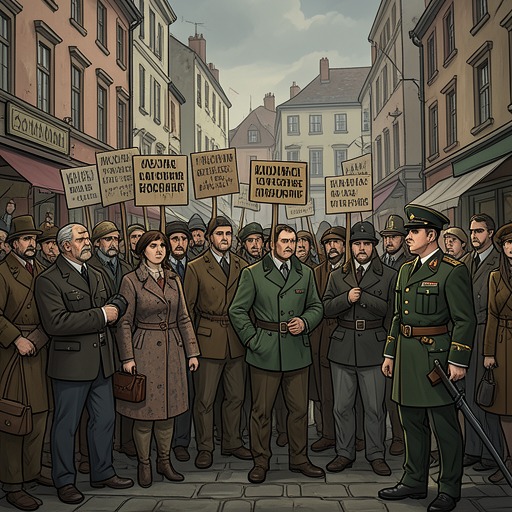
Walter Furst is introduced as one of three men appointed to present the people’s complaint to Gessler. The narrator gives each spokesman a memorable sketch: Furst has red hair and looks fierce; Werner Stauffacher has gray hair and worries about how to pronounce his own name; Arnold of Melchthal is light-haired and thought to know much about the law. Furst’s appearance becomes an immediate part of his public role. His companions push him forward because they believe his fierce look might frighten the Governor, making him the chosen face of a delegation whose cause is shared by all three.
The complaint arises under Austrian rule, as Gessler taxes a widening range of goods and livelihoods. Furst’s appointment places him among citizens willing to challenge that policy directly, though the story gives him no elaborate personal history beyond his place in this civic action and his later family connection to William Tell. His significance is built through what he does at moments when the community must choose between accommodation and resistance.
The First Appeal to Gessler
The three spokesmen visit Gessler on a morning in April and are admitted to the Hall of Audience. When the Governor asks what is wrong, Furst’s companions physically advance him as the one most likely to intimidate their opponent. He coughs, but the gesture does not become a show of force: the scene turns instead on the imbalance between the petitioners and the man who controls the audience.
Later in the exchange, Gessler asks whether Furst and Stauffacher share the other spokesman’s professed view that the rest of the people are satisfied. Both answer yes. Gessler treats their assent as proof that there is no grievance to address, then demands a payment to compensate the officials for granting an audience and an additional contribution for the Imperial boiling oil. The encounter therefore ends not with relief from taxation but with the petitioners required to pay again. Furst has been placed at the front because he looks formidable; in the Governor’s chamber, however, appearance cannot give the delegation power over the terms of the meeting.
From Petition to Rebellion
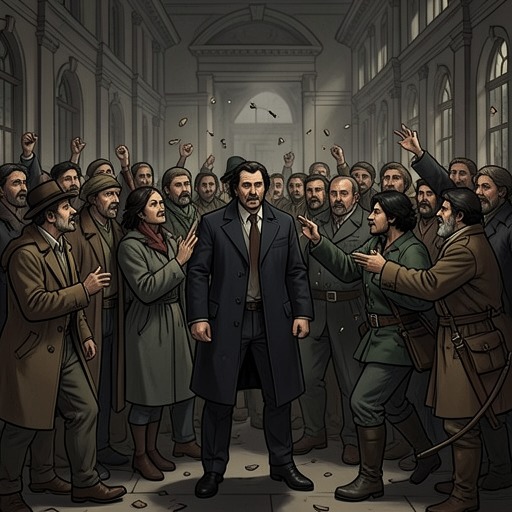
When the crowd asks whether Gessler will release them from the taxes, Furst answers no. He then draws a deep breath and states that the consequence is rebellion. The response around him is startled: the crowd repeats the word as a question, and Furst repeats it firmly. That second declaration turns a failed petition into an explicit political decision. He does not merely report the Governor’s refusal; he names the action the citizens must now take.
Furst’s firmness is set against the delegation’s earlier willingness to affirm what Gessler wanted to hear. The contrast gives his later declaration its force: before the Governor, the petitioners leave without winning their request; before the crowd, Furst makes plain that continued compliance is no solution. The narrative presents rebellion as a collective necessity voiced by him, rather than as a solitary undertaking.
Chosen Again as a Spokesman
When citizens meet at the Glass and Glacier to decide how to enlist William Tell, Arnold of Sewa argues that a new delegation should represent them. Stauffacher counters that it would be better not to keep changing spokesmen and proposes sending the same three who went to Gessler. The previous mission has plainly failed, and the discussion includes a pointed argument about whether poor tact caused that failure. The citizens nevertheless choose Stauffacher, Arnold of Melchthal, and Furst again.
Their renewed appointment gives Furst a second role as an intermediary: this time the delegation is to explain to Tell what the citizens want him to do. The stakes have risen beyond the tax appeal. The people consider a revolution impossible without Tell and worry that he may refuse leadership; they also recognize that a failed revolution could mean the leader’s execution. The three leave the inn after the citizens drain their glasses and climb the steep hill to Tell’s house. When they return without him, the crowd suspects he may have refused, though his absence alone does not establish what he decided. Furst thus appears at the uncertain threshold between public resolve and the need for a leader.
Family, Mercy, and the Governor’s Power
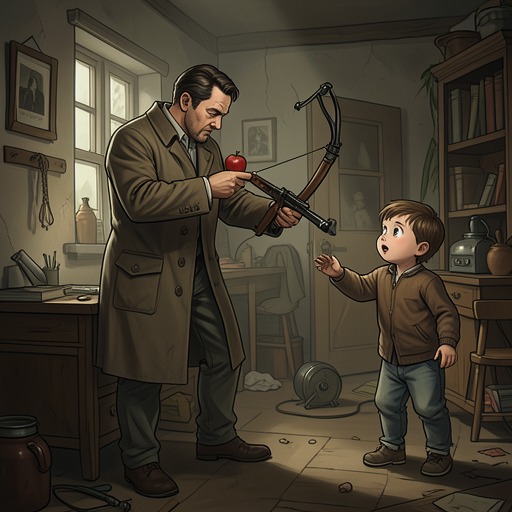
Furst’s public opposition to Gessler acquires an intimate dimension when the Governor threatens William Tell. At the meadow, Gessler portrays Tell as deliberately defying his authority and stirring discontent, then claims to offer him a chance to determine his own fate through a shot. In response, Furst flings himself to his knees before the Governor. He appeals to mercy, invokes a future English poet’s distinction between possessing a giant’s strength and using it tyrannously, and offers half his possessions if Gessler will spare his son-in-law.
The plea reveals both the relationship and the limits of Furst’s influence. He is William Tell’s father-in-law and Walter Tell’s grandfather, but neither kinship nor a proposed sacrifice of property can make Gessler relinquish control. Furst’s posture also sharply contrasts with his earlier designation as the fierce-looking spokesman: here he kneels, not to deny the Governor’s power, but to ask that it be restrained. Walter Tell interrupts and urges his grandfather to rise rather than kneel to a tyrant. He then asks where he must stand, declaring his confidence in his father’s ability to hit a bird in flight. The scene places Furst’s plea beside the boy’s defiance, leaving visible two responses to danger within the same family: an appeal for mercy and a refusal to submit in spirit.
Narrative Role
Furst’s importance lies in the sequence of public and private choices attached to him. He is pushed forward as a possible intimidator, participates in a failed appeal, announces rebellion when that appeal brings no relief, and is selected again to help secure Tell’s involvement. At the meadow, he turns from civic spokesman to pleading relative. These actions do not show a change in his opposition to Gessler; they show how resistance takes different forms as its stakes shift from taxes to revolutionary leadership and then to the immediate peril facing his family.
The account also gives Furst a deliberately comic surface, from his conspicuous red hair and companions’ confidence in his fierce appearance to the awkward transaction imposed in the audience chamber. That comedy does not erase the danger beneath it. His declaration of rebellion carries the crowd past petition, while his kneeling plea exposes how little leverage even a determined citizen has before the Governor. The character’s arc, as presented here, ends with the threatened family crisis unresolved in these scenes.